This interview was conducted with Diana Yeghiazaryan, Executive Director of INEDNET.
The Information and Education Development Network (INEDNET) empowers young people to build inclusive, peaceful, and resilient communities. It promotes human rights, equal access to quality youth work, and active civic participation, guided by values of accountability, collaboration, compassion, empowerment, impact, and inclusion.
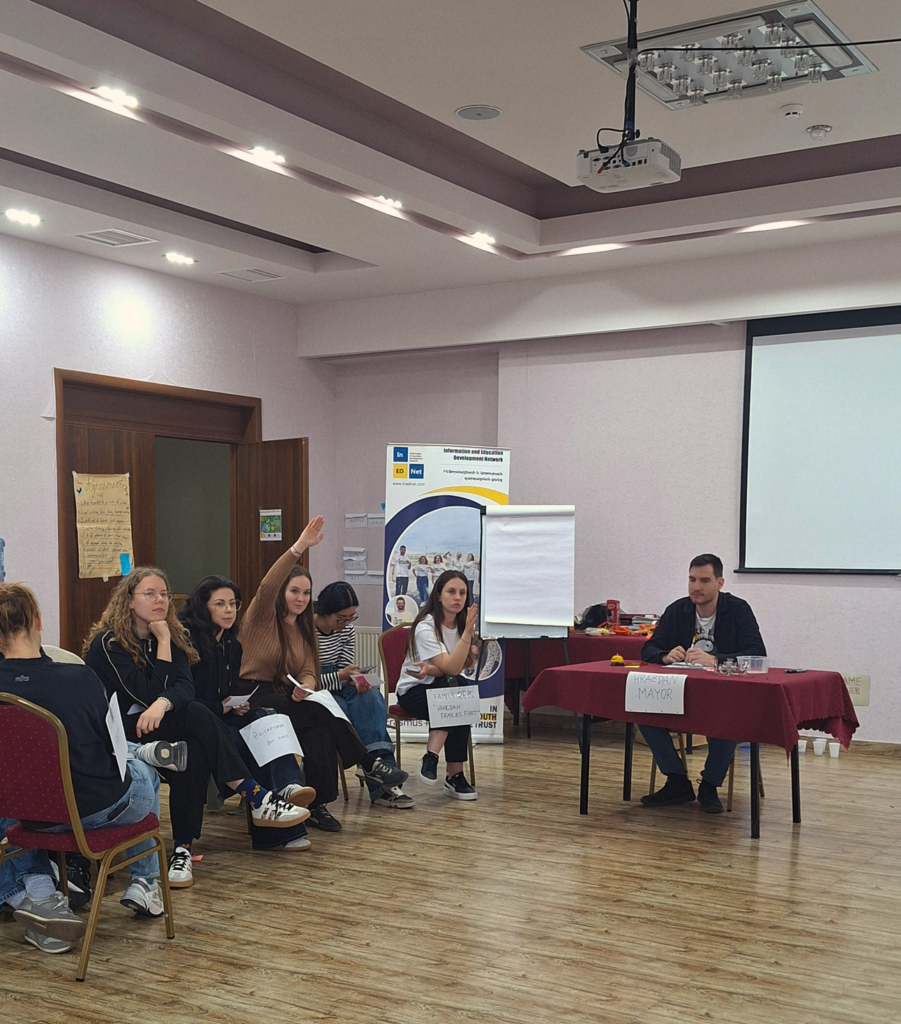
Together with European partners, INEDNET recently implemented BUDGETIFY, an initiative designed to make participatory budgeting (PB) accessible and practical for young people across seven countries: Armenia, Moldova, Germany, Hungary, Portugal, Slovakia, and Sweden.
At its core, BUDGETIFY addresses the idea that public finances should not be seen as distant or overly technical, but rather as an accessible tool directly connected to everyday community life and local decision-making.
Diana Yeghiazaryan: “While financial literacy is increasingly taught in schools, covering personal savings, income, and budgeting across subjects like Mathematics, Algebra, Social Studies and “Me and the World Around Me” there remains a distinct gap between managing personal finances and navigating municipal budgets. Knowing how to manage your own budget does not automatically mean knowing how a municipal budget works, how public money is allocated, how to estimate the cost of a project, or how to argue why a proposal should be funded. Here our project targets and combines both active citizenship and participation and applying for PB real projects to change something in their communities.
What fields are young people’s project proposals in Armenia gravitating toward today?
Diana Yeghiazaryan: “From what we observe through local initiatives and our work with young people, proposals tend to be very practical and closely connected to everyday community life. They often relate to public spaces, sports and recreation, youth infrastructure, environmental improvements, community facilities, education, culture and opportunities for young people to spend time together in safe and accessible spaces.
What is interesting is that young people often identify very concrete issues rather than abstract policy questions. They notice what is missing in their neighbourhood or village, a friendly public space, a bus stop, a sports facility, better conditions for youth activities, environmental improvements or community services, and PB gives them a mechanism to turn that observation into a structured proposal.”
Learning Across European Borders
To enrich the local implementation in Armenia, the project incorporated a cross-border comparative dimension by mapping eight distinct PB practices across seven participating countries. The cases represented a diverse range of models, including municipal programmes, regional frameworks, youth-led initiatives, school-based approaches, and broader citizen participation mechanisms.
For the Armenian participants, comparing their local reality with systems in Moldova, Germany, Hungary, Portugal, Slovakia, and Sweden demonstrated that fundamental challenges, such as accessibility, voting mechanisms, proposal evaluation, youth inclusion, and accountability, are shared across different contexts.
Diana Yeghiazaryan:“The biggest value of the cross-border process was not to identify a “best” model, but to understand what elements can be transferred or adapted. It allowed young people to look at their own local reality with fresh eyes and ask: what works elsewhere, why does it work there, and what could realistically be adapted to our own communities?”
Moving from Words to Action
As BUDGETIFY moves into its next stage, the focus is on bringing these practical tools directly into local communities, strengthening dialogue with decision-makers, and building long-term civic engagement.
Diana Yeghiazaryan: “One thing I would really like to underline is that for us BUDGETIFY is not only about budgets. It is about helping young people understand that they can have a role in decisions that shape their communities.
The project has also developed two practical resources: “A Youth Workbook on Participatory Budgeting: My FIRST PB Project”, which guides young people step by step, from understanding PB to developing their first project idea, and a comparative mapping study of eight participatory budgeting practices across seven countries.
Our next step is to bring these resources back into local work — testing them with young people, discussing them with practitioners and decision-makers, and continuing to build stronger links between youth participation and local democratic governance. We are currently planning a nationwide PB Youth Forum in Yerevan, Armenia on 7 November, where we will host speakers from Ministries, NGOs, Municipalities and International Institutions, young people will come together to exchange biggest achievements, challenges and make some recommendations on the topic.
For us, the most meaningful outcome is when young people move from saying “someone should solve this problem” to “we have an idea, we understand the process, and we know how to propose it.”
🙋♂️ BUDGETIFY is a project implemented by the Information and Education Development Network (INEDNET) Armenia together with its European partners.
☑️ Download “Mapping Participatory Budgeting: A Comparative Research and Mapping Study Across Communities in Armenia, Germany, Hungary, Moldova, Portugal, Slovakia and Sweden” here:
👉 http://toolbox.salto-youth.net/5978
☑️ Download “A Youth Workbook on Participatory Budgeting: My FIRST PB Project” here:
👉 http://toolbox.salto-youth.net/5979
💡 Learn more about the project, its activities and tools here:
👉 https://www.inednet.com/budgetify